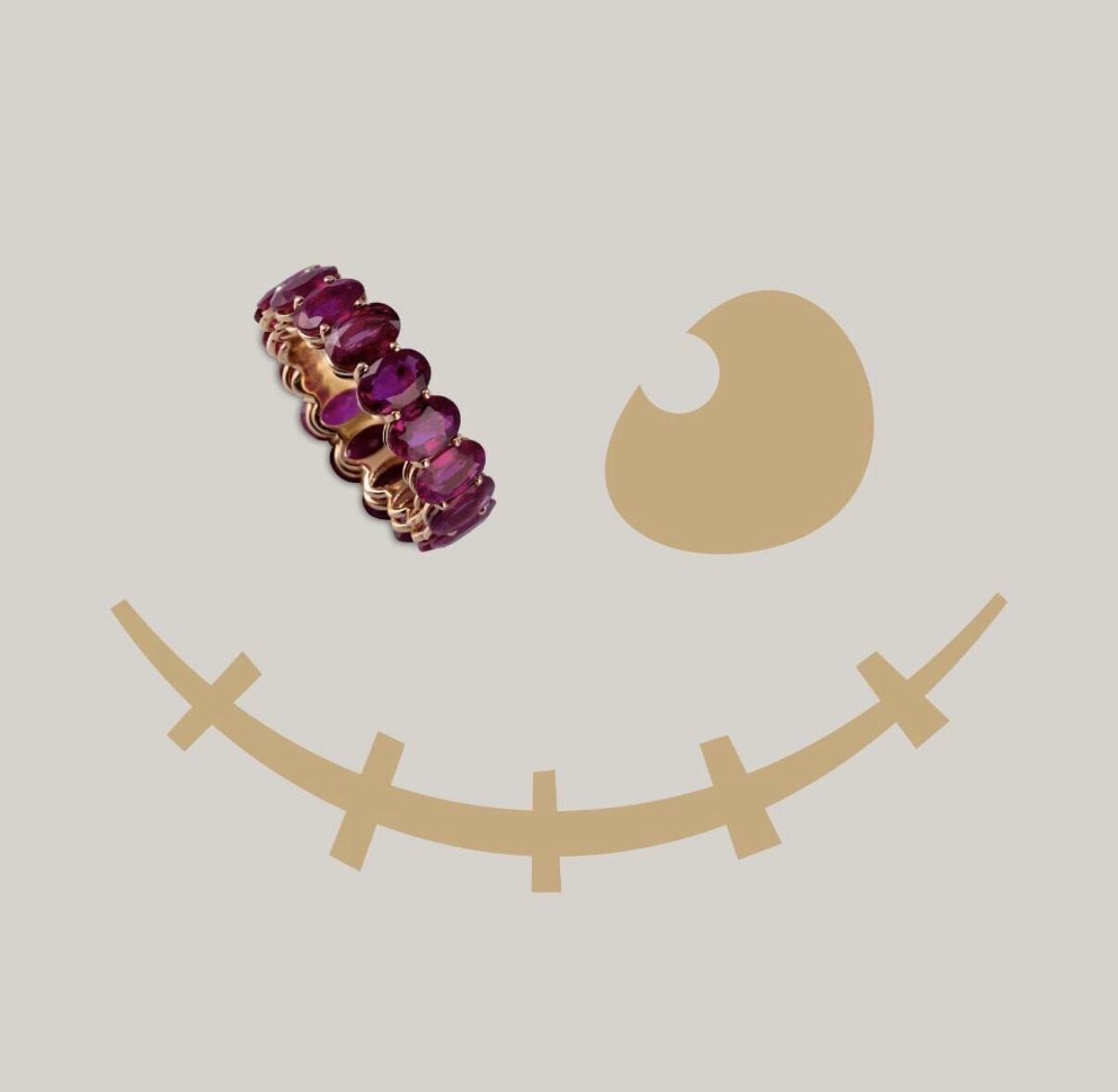
October is the perfect month to fall under the spell of a good mystery. The days draw in, the clouds hang low and, as Halloween approaches, ghosts, witches and curses come back into fashion.
The world of jewellery has its own legends: diamonds said to bring misfortune, gems no one dares to touch, warning letters sealed inside seven boxes.
Look a little closer, though, and these stories almost always have one thing in common: behind every curse there is a pen. A shrewd salesman, a writer in search of readers, a piece of fiction taken a little too seriously. Still, it's October, so let's give in, just for a moment, to the allure of cursed jewels.
The Hope Diamond: a curse made to measure
It is the most famous blue diamond in the world and, as if that weren't enough, it comes with a dark reputation. According to legend, whoever owns it should prepare for a life of misfortune.
Yet this "curse" has a date and an author. In the early twentieth century, the jeweller Pierre Cartier was hoping to sell the diamond to a wealthy American heiress, Evalyn Walsh McLean. To make it irresistible, he gave it a past filled with owners who had fallen on hard times. The touch of mystery worked: in 1911, McLean bought it.
The diamond later passed to the jeweller Harry Winston, who donated it to the Smithsonian in Washington in 1958. The museum's curators have never believed in the curse, and the Hope Diamond has since drawn millions of visitors.
The amethyst that passed for a sapphire
The Natural History Museum in London holds a purple stone known as the "Delhi Purple Sapphire". The first mystery lies in its name: it isn't a sapphire at all, but an amethyst.
The two may look alike, but they are very different stones. Sapphire is one of the hardest gems in nature, second only to diamond, and comes in many colours, purple included. Amethyst is a purple quartz: softer and far more affordable. Only a gemmologist's eye can tell them apart with certainty.
The legend begins in 1857, when a British soldier is said to have taken the stone from a temple of Indra, god of war, in Kanpur, India. It ended up with Colonel W. Ferris, who brought it back to England. From then on, so the story goes, his family knew nothing but illness and financial ruin.
In 1890 the colonel's son gave the stone to Edward Heron-Allen, a writer with a keen interest in the occult, who had it set in a serpent-shaped ring surrounded by zodiac symbols and protective charms. It didn't help: friends he entrusted it to were struck by misfortune, among them an opera singer who lost her voice. Exasperated, Heron-Allen threw the stone into Regent's Canal, but a few months later a dredger fished it out and the amethyst found its way back to him.
When his daughter was born, Heron-Allen resolved to make it disappear for good. He locked it inside seven boxes, one within another, and left it at his bank with instructions that it should not be opened until 33 years after his death. His daughter didn't wait that long: in 1944, just months after her father died, she gave the stone to the museum.
The consequences? None. According to the curators, the most likely explanation is that Heron-Allen invented the whole thing to lend credibility to a short story he published in 1921 under a pseudonym, entitled, fittingly enough, The Purple Sapphire.
The Koh-i-Noor: a legend without an author
Its name means "Mountain of Light" in Persian. The Koh-i-Noor is one of the most famous diamonds in the world and is now part of the British Crown Jewels, which it joined in 1849 following the annexation of the Punjab.
Since arriving in England, it has only ever been worn by queens: Queen Victoria as a brooch, then Queen Alexandra and Queen Mary in their crowns, and finally the Queen Mother, in the crown made for her in 1937. Today it is on display at the Tower of London.
Legend has it that the diamond brings bad luck to any man who wears it. No one knows for certain where the story began and, as is so often the case, a legend without an author is almost impossible to disprove.
Opal: blame it on a novel
To the Romans, opal was a symbol of love and hope. Yet in the nineteenth century, even this stone acquired a dark legend.
In 1829 Sir Walter Scott published Anne of Geierstein, a novel in which an opal is bound up with the tragic fate of a noblewoman. Readers were so captivated that they took the fiction for fact, and for decades opal carried the reputation of an unlucky stone.
Not everyone fell for it. Queen Victoria, entirely unmoved by the superstition, loved opals so much that she gave opal jewellery to each of her daughters on their marriage. And the GIA, the world's most authoritative gemmological institute, points out that for most of history opal was considered the luckiest of all gems, precisely because it holds every colour within it.
Jewels that protect, not threaten
Looking at history as a whole, precious stones have far more often been talismans than curses. They were worn for protection, to attract good fortune, to keep a promise close.
And in the end, that is the true power of a jewel: the story it carries. Not one invented by a novelist, but the story of those who gave it, wore it, treasured it and passed it on.
Do you have a family jewel with a story to tell? Come and visit us at our boutiques in Sondrio and Livigno: we'd love to discover it with you.